Showing posts with label analysis. Show all posts
21/03/2018
Dragon's Dogma plot structure
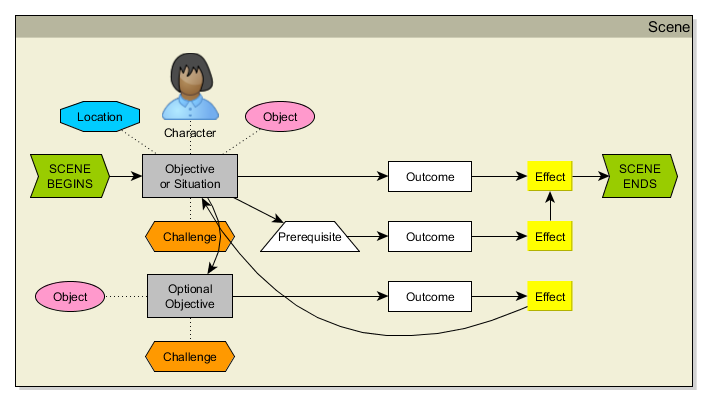
As part of the early stages of my PhD research, I've been studying branching narratives and trying to come up with a consistent system for diagramming them. This image represents my current solution, and this approach seems to work for any game that I've tried so far, including tabletop RPGs.
I'm currently only looking at the structure of how the branching narrative functions, rather than any actual story content. The goal is to be able to disassemble and reassemble these structures, to fit the current status of the story. It's early days yet.
Here's a sort of key for the diagram:
06/06/2017
Thoughts on Dark Souls - The Board Game (Lost in Translation)
I recently played Dark Souls - The Board Game and had some thoughts that I wanted to share. While I’m not saying that it's a bad game, I do think it’s a bad translation of the video games into a board game. In particular, there’s major friction between the video games’ emphasis on skill-based gameplay and the board game’s emphasis on luck-based gameplay. I know that the video games include some reliance on luck and the board game includes some reliance on skill but their balances are massively different.
Most noticeably, I found the character progression to be very unsatisfying in a way that goes against the feel of the video games. The souls (currency) that you earn in the board game (at a frustratingly slow rate, I found) can be used to progress your character in one of two ways. You can either level up your stats (strength, dexterity, intelligence and faith) or buy new item cards from a deck. Both of these options have major flaws, in my opinion:
09/03/2017
Apps for Mental Health
I'd like to take the time to share some recommendations for a few free apps for smartphones (I'm on Android but hopefully they are on iPhones too) that I feel help me to manage my own mental health. To give you a little context, I suffer with depression and anxiety and have been taking medication for it (on and off but mostly on) for a few years. I know that there are often stories going around about how smartphones and social media can be bad for mental health but I certainly feel like my phone is one of the biggest factors in helping me stay on top of things and it definitely has a positive impact on my mental health (when used correctly). And so, on to the list:
And that is the end of my list. I didn't want to throw too much information at you so I stuck to the apps that I feel help me the most and tried to give some insight as to why so that you can get an idea of whether they might be good for you too. If you have any questions or would like to discuss anything I mentioned here or mental health in general, please don't hesitate to get in touch. I'm happy to talk about my experiences, especially if it might benefit others or help with understanding.
Daylio
Probably the most useful and effective of the apps that I use is Daylio. It works like a sort of micro-journal for moods and activities so allows me to inject small doses of cognitive behaviour therapy (CBT) into my day-to-day activities. At any time during the day, I open the app and record my mood (on a scale), what activities I've been up to recently (via selecting from user-defined icons) and a short statement about how I'm feeling and why (if I wish). The app then provides insights into mood and activity patterns, including charting mood over days, months and years and showing which activities are linked to which moods. This grants me a great insight into my behavioural patterns and allows me to improve my emotional intelligence. Even just the fact that I'm taking a little time to assess and analyse my moods and activities each day is a great help - it keeps me mindful and present. I highly recommend doing something similar.Habitica
Combining a habit tracker, recurring tasks and a to-do list with some light game elements, Habitica is a great way to gamify (make a game of) your important tasks. Checking off your daily tasks, completing to-dos and fulfilling good habits rewards you with items and fake currency that you can use to improve the little character that represents you. Conversely, missing tasks and partaking in bad habits causes injury to your character. Once you've been using it for a while, you unlock more items, level up your character and unlock skills that you can use in the game for certain benefits. Importantly, you also gain the ability to form a group with other users and combine your efforts to resolve quests together. This group accountability can help push you to achieve your goals and not let your team down. I really like having access to this method of tracking my achievements and the little extra rewards (though not real) that I get for accomplishing my goals give me an extra reason to be productive.Zombies! Run
To follow the theme of gamifying things that I should be doing anyway, Zombies! Run is the way that I make myself get outside and run or walk more. It is similar to other run trackers (Endomondo/Runtastic) in that it maps where you go and how fast you go there and all that. On top of that, there are some light game and story elements. Over a series of episodes (one run at a time), a post apocalyptic zombie survival story is presented to you purely through audio while you are out running. It frames your runs as reconnaissance and supply missions for a colony of survivors (including optional zombie chase segments, to boost your speed) with other characters speaking to you directly. Between runs, you can use the supplies that you found in a simple management game of upgrading your settlement. Again, having that extra level of rewards and progression encourages me to do these positive things more frequently. Whether it's because I want to improve my fitness or find out what happens next in the story, the runs are just as good for me.Down Dog
Allowing me to quickly set up custom yoga practices (read: short and low-level, for now) with spoken instructions and photo guides, Down Dog really helps make yoga accessible to me. The benefits of exercise with regards to mental health are well-known and yoga also improves flexibility and includes a sort of meditative element which I think helps with mindfulness and stress-management. I really struggle with commitment to classes and motivation though, so being able to quickly get into an activity when I can muster the energy or will is very important to me. This app really helps me in that respect. It also doesn't cost anything (unlike classes), so that's good too.And that is the end of my list. I didn't want to throw too much information at you so I stuck to the apps that I feel help me the most and tried to give some insight as to why so that you can get an idea of whether they might be good for you too. If you have any questions or would like to discuss anything I mentioned here or mental health in general, please don't hesitate to get in touch. I'm happy to talk about my experiences, especially if it might benefit others or help with understanding.
08/08/2016
Misrepresentation?
I've recently been witness to a discussion about whether or not somebody (specifically, a heterosexual, cisgendered white man) should give a presentation about the representation (in a particular medium) of a social group (a minority) that they are not a part of. Some members of the given social group were wary of having a privileged person speaking on their behalf with no inside knowledge of the issues that they've faced, stating that a member of said group should be giving a presentation instead (or that the presenter's talk should be on another subject). Others were supportive of the presenter, stating that he is knowledgeable about the medium in question, has spent years researching this particular topic (including speaking with many people from said social group) and would approach it with care and consideration. It may be important to note that the presenter was invited to give a talk on any subject he wanted - he chose the representation of said social group in said medium - he wasn't invited in the place of somebody from that group.
This has troubled me. I am of the opinion that anybody should be able to give a presentation on any subject, so long as it is well-researched, considerate and useful. But I am not part of the social group mentioned above, so maybe my opinion is invalid. I certainly don't want to offend anybody.
05/10/2015
Ultra JankenSquad Forever playtest
We had a pretty good playtest of Ultra JankenSquad Forever at the lovely Cardiff BRAWL's All Day Roleplaying event yesterday.
JankenSquad (for short) is my anime-inspired, Rock-Paper-Scissors RPG system. It makes for an easy, fun and quick game with a lot of player power. The emphasis is definitely on the roleplaying rather than any complex rules simulation. That's fairly obvious though, given the simplicity of the R-P-S system. Having each of the three choices represent an approach to a situation, rather than a specific action or skill, gives the players a huge amount of freedom, which they seemed to enjoy. It does mean the GM has to be on top of everything and represent NPC and environment challenges fairly.
One issue is that it can be a bit easy for players to overcome challenges, given that they always have at least a one in three chance of beating the GM in a check. This isn't necessarily so bad, though, as long as the story is moving along fine and the players are having fun. The GM could always require several successes to resolve a problem or something like that. Also, it can sometimes be fairly obvious what the "correct" approach to a situation is (for example, Guile/Paper would always seem to be the right approach to a stealthy situation). This can be overcome by everyone bearing in mind that each of the three approaches can be applied to any situation. In the stealth example Resolve/Rock can represent careful, slow movement, Guile/Paper can represent outmanoeuvring/outwitting the enemy and Aggression/Scissors can represent dashing from cover to cover.
I've been thinking about writing up the rules and making them available online as a PDF or something. Maybe I'll sell a deluxe edition with pretty pictures for a modest fee. I'll add this to my list of projects to do.
28/01/2011
5 days of my plot structure
Following on from the previous images - I decided to map my own plot structure for five days. This is the result. It's interesting to see which loops occur frequently, and just which parts of my days are often the same.
As a theme, I'm finding these illustrations of structures to be an interesting topic. Particularly with the previous structures of game books - I'm illustrating a story, but with no mention of the narrative within my image. Yet I find the outcomes quite beautiful. They are illustrations of the structure, the underlying mechanics. This is an idea I am going to explore further.
21/01/2011
House of Horror plot structure
Here is another plot structure diagram. This time I mapped House of Horror, also from the Fighting Fantasy Project.
It occurred to me, after posting the Hellfire plot structure below, that the sketch image that I had made whilst playing was more interesting than the re-done image that I posted. So this time I went straight in with a pen and decided to post the results. It's a little messy, but I think it makes for a more intriguing illustration of my experience of the game's structure. Isn't it beautiful? I find the structure sort of mesmerising.
These images don't quite contain enough information. There are some aspects of the games that I haven't been able to record. For example - some parts of the story can be re-directed depending upon which items the player is carrying. I may work on a more complex method of representing these factors, but I like these diagrams the way they are.
It occurred to me, after posting the Hellfire plot structure below, that the sketch image that I had made whilst playing was more interesting than the re-done image that I posted. So this time I went straight in with a pen and decided to post the results. It's a little messy, but I think it makes for a more intriguing illustration of my experience of the game's structure. Isn't it beautiful? I find the structure sort of mesmerising.
These images don't quite contain enough information. There are some aspects of the games that I haven't been able to record. For example - some parts of the story can be re-directed depending upon which items the player is carrying. I may work on a more complex method of representing these factors, but I like these diagrams the way they are.
08/10/2010
Interactive drawings
I did a little research project into interactive drawings a while ago. The above diagram basically sums up my findings.
The first type of interactive drawing - an image containing a set of rules - could be, for example, a 'Where's Wally?' image or a maze.
The second type of interactive drawing - a set of rules containing an image - could be, for example, a dot-to-dot puzzle or one of those grid-based, Japanese logic puzzles containing an image.
The first type of interactive drawing - an image containing a set of rules - could be, for example, a 'Where's Wally?' image or a maze.
The second type of interactive drawing - a set of rules containing an image - could be, for example, a dot-to-dot puzzle or one of those grid-based, Japanese logic puzzles containing an image.
28/01/2010
Hello again / Interactive narrative collection

It's been a while since I've posted. I feel as if I've neglected my blogging duties. I have been busy though.
Recently I've been collecting narratives with which I have interacted, i.e. video games, board games, card games, interactive fiction, gamebooks... This is my area of interest, so I have been reflecting upon and analysing the different methods used - strengths and weaknesses and such. Above are some of the pages of the book I've been filling, I don't think you'll be able to read them though.
This has led onto the project I'm working on at the moment - I'm creating my own interactive narrative. I did recently design a board game, but it wasn't really narrative driven. I am planning on making a card game. Though I may introduce dice and a gamebook element. It's early stages yet, I'll post updates as they come.
Subscribe to:
Posts (Atom)